The Salvation of the Universe

I. Introduction
II. Prologue
III. Genesis
IV. Acts
V. Revelation
VI. Exodus
VII. Epilogue
INTRODUCTION:
The idea of this essay came from a question and an observation:
Question: Humankind has progressed in the past, but what are we progressing towards?
Observation: Scientists have reached a consensus that the Universe will end in the future.1
We say that the Universe—our humble abode—will one day end, and then we leave it at that, without discussing the incredible consequences this statement has for the future of humankind!
So, we have progressed in the past and the Universe will end in the future. After much reading, research, and existential rumination, I will try in this essay to describe an answer to this reality-shaking problem and, if I may be so bold (I am), solve some fundamental questions about Existence.
What is the direction of progress?
What is the purpose of humankind?
PROLOGUE:
Before the reader begins, I encourage them to enter the mindset of what a philosopher once called sub specie aeternitatis—from the perspective of eternity.2 Let us take a seat outside of space and time, beyond the edge of the Universe, so that, looking down, we can see all of Creation, from the beginning of time to the end.
Our task is to build a philosophy; one that can hold the Universe. We shall build a system of thought to serve as a framework for our knowledge, and with that system and framework, we shall will try to discover our place in Creation. After discovering our place, we should know our purpose.3 But first, we must begin anew.
The philosopher Rene Descartes, before he made a new philosophy, began by “rejecting all doctrines and dogmas, putting aside all authorities; he would start with a clean slate and doubt everything.”4 He said that the "chief cause of our errors is to be found in the prejudices of our childhood…principles of which [we] allowed [ourselves] to be persuaded without inquiring into their truth.”5 So, first we must empty our minds. We will fill it again with color, wonder, and truth.
A historian once said that the age of system-making in philosophy has passed.6
Let us try once more.
Time to set the stage.7
GENESIS8 — the Universe:
A philosopher-rabbi once wrote, “It is impossible to communicate to man the stupendous immensity of the creation of the Universe.
Therefore the Bible simply says:
In the beginning, God created the heavens and the earth.”9
In the beginning, “ “ created the Universe.10
How? Why? We do not yet know.11 Beyond the infinity of the Universe and before the beginning of time, there is the Great Unknown. Science and religion make their claims there—science for the how (“How was the Universe created?”) and religion for the why (“Why are we here?”)—but in that realm of the unknown, all the theories of science and stories of religion are, at present, the same: equally majestic and equally foolish.12
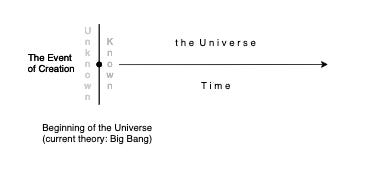
Yet on the other side of this veil to the Holy of Holies—after the beginning of the Universe—we enter the realm of the Known. And here science can tell us a story.13 One that speaks with the grandeur of the biblical one.
So came the Big Bang theory: our scientific explanation of the origin of the Universe.
After raising our eyes to the stars above, we observed that the Universe is expanding—that the stars and galaxies are moving further and faster into the deep.14 And then we thought: if time was reversed, the Universe would recede; and it would continue to recede until everything collapsed onto a single point of time and space.15 An original point from which the Universe was created.
The Event of Creation.
Here though, the Big Bang theory ends. It can describe the life of the Universe, but it cannot explain its birth. It can tell of what came after the Event of Creation, but not of the event itself.
So, for now, the questions “How?” and “Why?” are left unanswered, and our past remains a mystery.16
But not our future.
And with the beginning, came the end.
“So did the world from the first hour decay…” a poet wrote.17
Yes, and in “the final hour unknown to us…” it will end, a pope replied.18
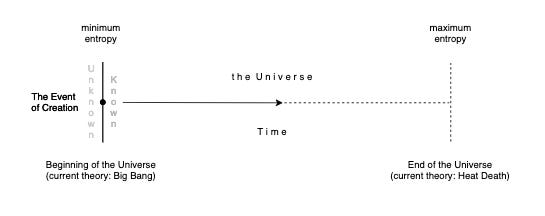
So, the Universe began from an original point in time and space, when all matter and energy were bound into one. And everything was in perfect order.19
Then, the Event of Creation happened.
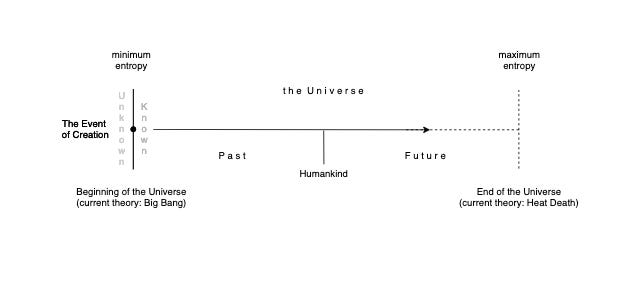
The original order was broken and chaos was released into space.20 Matter and energy spilled out into the Universe and spread across the expanding deep. Order now mingled with chaos and mixed with it. The Universe began to change as things formed and fell apart and formed again. And with the Universe changing, there was now a past, a present, and a future.
Thus Time began.
With time now passing, there was a beginning and there would be an end. After the beginning, the Universe expanded further and faster into the deep; and in its wake, the stars, planets, and galaxies formed. And the Universe will continue to expand further and faster throughout the future.
But one day, far into the future, the size of the Universe will become too much, the distance of space too great. Light, matter, and energy will no longer be able to travel across the Universe and reach other things. Order and chaos will no longer mix, so when things fall apart, they will not form again. The stars will fade, the planets will crumble, and the galaxies will scatter. The Universe will decay until there is nothing left to decay and all will become a field of nothingness. Space will grow cold and empty as the Universe becomes a desert of darkness.21 In the beginning, the Universe was like dust and “to dust it shall return.”22
In the end, Creation will be destroyed. It will be without form and void, and darkness will be over the face of the deep. Nothing will move over the face of the waters. Time will say, “Let there be darkness,” and there will be darkness.23 Forever.
This is the original sin of Creation.
The burden of our being and the knowledge we are cursed to bear:
We live in a dying universe.
But before death, there is life.
Between the first hour and the last, a playwright wrote,
“there will be many wonders,” in the Universe,
“but none more wonderous than humankind…”24
In the dawn of time, the Universe was filled with incredible heat. Matter and energy spread but could not form, for the heat would break it apart. But after some time, the Universe cooled and the heat dissipated.
And as the Universe cooled, it entered a long night of darkness. Here, the Universe was still without form, and darkness was still over the face of the deep. But now, the laws of nature were moving over the face of the waters.
And in that formless darkness, the Universe rested. Matter and energy swirled like a cloud of dust amidst the laws of nature. And as gravity gathered things together, the Universe slowly began to have form, and bodies were made from the dust.
Then “ “ said “Let there be light,” and there was light.25 And the first stars were born.
Now light flowed throughout the Universe and color bathed the infinity of space. Warmth spread across the expanse and galaxies gathered amidst the darkness.
The Universe became a garden.
Here now was a home.
And though, in time, the garden would decay and the home would vanish, the Universe would live long before it would die. And in that time between, something else would come to be born.
Time passed and the stars grew old. And when the old stars reached their end, they collapsed and exploded outwards in an awesome shower of color, light, matter, and energy. The seeds of life poured from the womb of the stars and were cast into the wind of the cosmos. The wind flowed throughout the Universe and fell upon the face of a young world. And upon that world, the seeds rained down. And planted there, the seeds grew and became life.
Then came us.
ACTS — Humankind
In the early days of “the legendary ancestral world” called Earth,26
there were beings who “lived without laws just as wild animals.”27
Then one day the ancient voice of self-preservation awoke within them.
The beings asked the voice who it was,
and the voice said “I am that I am.”28
Then the voice asked the beings who they were,
and the beings said “I think, therefore I am.”29
Then the voice commanded the beings:
“Be fruitful and multiply;
subdue the earth and replenish it,
and have dominion over it,”30
for by doing this they could “eat, drink, and be joyful.”31
Now the beings came to know “all the tasks of the land,”32
and so began their becoming.
And with life, came humankind.
“In the beginning was the word,” for with it, humans became humankind.33 With language, the early humans gathered themselves together. And once gathered, they began to multiply in number. Now the early humans were gathered and bound together by language and multiplying. So the early humans formed a civilization—a civilization called humankind.34
Before the gathering, the minds and muscles of humankind were scattered, so the early humans had no knowledge and power.35 But after the gathering, their minds and muscles combined, and humans could learn and work together. Now humankind had knowledge and power. 36
So the early humans looked at the world and learned how it worked, how it used matter and energy—the earth and the forces of nature—to do things: to move and build and grow and destroy. And humankind gained knowledge of the world.
With knowledge of the world, of how it worked, the early humans learned to do work themselves, how to use matter and energy—by shaping the earth into tools and harnessing the forces of nature—to do things: to move and build and grow and destroy.37 And humankind gained power over the world.
So the early humans gained knowledge and power, and now they could begin their work. They would subdue the land, replenish it, and build upon it a Dominion of Joy.
Their first task was survival. And for that, they needed food and defense.38
Since every form of life needs food, and food comes from the earth, the early humans worked together to subdue the land. If they could learn to subdue it, then they could use their knowledge and power to replenish it, and with replenishment came abundance. So the early humans learned how nature grew things, and they turned this knowledge into power and began to grow food from the earth. Thus agriculture began.
With agriculture, the early humans could extend their control over the world. They increased the fruits of the Earth and made their stores of food abundant. No longer did they live in fear of hunger.
But the early humans were still surrounded by the wilderness of the world, a wilderness that could steal their food, destroy their work, and end their lives. So the early humans worked together to protect the dominion that they established. They learned how nature destroyed things, and they turned this knowledge into power, and they armed themselves against the wild destruction of nature and other humans, and they began to protect themselves. Thus defense began.
With defense, the early humans could protect their dominion, their work, and their lives. No longer did they live in fear of destruction.
So with agriculture and abundant food, the early humans had peace. And with defense and safe-living, the early humans had freedom. And in that peaceful freedom, after all the basic work was done, the early humans could give their time to the other tasks of the land—to grow their civilization and build their Dominion of Joy.39
So the early humans gathered together again, but now in greater numbers and smaller place. They saw that this was better than when they were scattered, for now they could live and think and work together. So the early humans made for themselves a city.40 And in the city, the early humans worked in the peaceful freedom that they created with agriculture and defense, and they began to write things, build things, trade things, and travel the world.
This meant nothing to the Universe, but for humankind, it was the beginning of everything.
With writing came songs and stories, laws and love poems, debates and dramas. With building came tools and machines, homes and temples, arts and monuments. With trading came commerce and numbers, roads and wealth, pleasures and crafts. With traveling came land-crossing and ocean-sailing, expansion and conquest, exploration and discovery.
Not since the beginning of the Universe was there such new creation.
And now the Universe itself began to change, not by the laws of nature like all time before, but by the hands of humankind.41 The early humans were moving around the face of the earth and replenishing it. They were molding the matter of the world to their will and subduing the forces of nature for their use. In all of this, humans were shaping the world to their dreams. They created what they saw as good by the imagination-command of their work.
The descendants of Creation became creators themselves.
And as the early humans learned more about the world, they could do more in the world. And as their knowledge grew, so did their power. And as their power grew, so did their dominion.
Among the wilderness of the world, they had made a home for humankind.
And with a home, the early humans had one final task:
To give it all to their children.
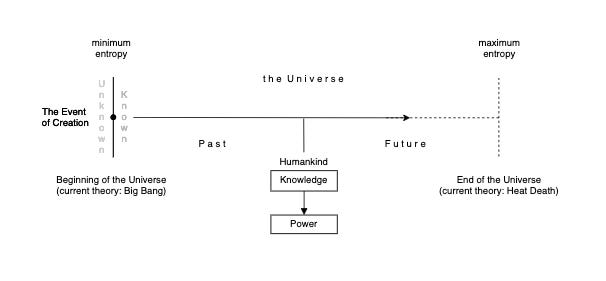
And with humankind, progress.
So the beings became “filled with ability and intelligence,
with knowledge and all craftsmanship,”42
and they built for themselves a dominion
“whose foundations stand firm as heaven and earth.”43
The beings saw that
“all the world fears time,
but Time fears the pyramids,”44
so they said to themselves:
“When we build, let us think that we build forever.”45
And now their works would endure.
This would go on for generations.
Every generation would learn. Every generation would build.
Knowledge would grow. The Dominion would spread.
And one day the beings would
look to the past and say:
“See how our works endure!”46
“Our dominion endures through all generations…”47
And they would look to the future:
“We shall be everlasting…”
So the early humans gathered themselves into a civilization and called it humankind. They worked to subdue the land and establish a Dominion of Joy upon it. They learned the way of things and accumulated knowledge, then they turned this knowledge into power and extended their control over the world. They did these things and many others and saw that they were good—for now they had a home. Then many days passed, and the early humans began to grow old.
The old humans saw that they were approaching the end of their lives; that, soon, they would die. They were afraid of this, for they had accomplished many wonders throughout their days. They built a civilization with their hands. They established a Dominion of Joy with their minds. They created a home with their hearts.
They could not let it be for nothing.
They would not let it be for nothing.
So, like the old stars that passed the seeds of life in their death, the old humans gathered their children—the young humans—and made a promise with them: a promise of hope. The old showed the young the civilization that they were a part of, the dominion that was theirs, and the home that they would inherit. Then the old humans gave their knowledge to the young. And they gave their power to them. Thus education began.
From then on, the world would pass from generation to generation. And from generation to generation, the young would add to the knowledge and power of the old.48 Civilization would grow as the Dominion of Joy was spread, and the home of humankind would endure.
Here was an everlasting covenant between the generations.49
Here was progress.
One covenant was given and another was made.50 The old said to the young: “I will make a covenant of peace with you; it will be an everlasting covenant. Our home will be established and our numbers will increase. Our dominion will be among us forever…I will never stop doing good to you. I will inspire you.”51
Now the old humans could pass in peace. No longer did they live in fear of death, for life would remain after them—civilization would not die with them. The old humans had built a civilization to survive in the wilderness. And now, with progress, humankind would survive throughout time. The young would continue the work of the old,52 they would build greater wonders than before,53 and they would “do marvels never done before in all the world.”54
And this would go on.
As time passed—as the Universe expanded further and faster into the deep—the humans crossed all the fields, sailed all the oceans, touched all the clouds, and tamed all the animals that roamed the world. They progressed throughout the generations and extended their dominion to the ends of the Earth. By coming to know the wonders of the world, they subdued the wilderness of the world. And in time, they made the entire Earth the homeworld of humankind.
Now their first task—survival—seemed done.
So the humans thought to themselves: “Surely now our work is complete. Surely now our home will be everlasting. Surely now we can rest.”
And as they thought this—on the world they now ruled with the civilization they built and all the wonders they created—a trillion stars died, a billion galaxies collided, a million planets crumbled, and a thousand years of destruction had passed throughout the Universe. The humans had ensured their survival on the planet Earth by gaining power over the wilderness of the world, but they were powerless against the wilderness of the Universe.
So the humans learned this: the Earth was their cradle, but they could not stay in their cradle forever.55 They accomplished many wonders throughout their days, but there was still more work to be done; they could not yet rest. There was more knowledge to learn and more power to have, there were more worlds to conquer and more wilderness to subdue,56 there were more marvels to create and more dominions to build.
Yes, there was more work to be done.
There is far more work to be done.
So the humans raised their eyes from the earth to the stars, and there, they searched for their next task.
But as they looked deeper into the Universe, they came to learn its fate. Written in the stars, they saw that the Universe would be consumed by destruction. One day, humankind would come to an end.
So the people of Earth learned the original sin of Creation.
And then, they said, “No.”
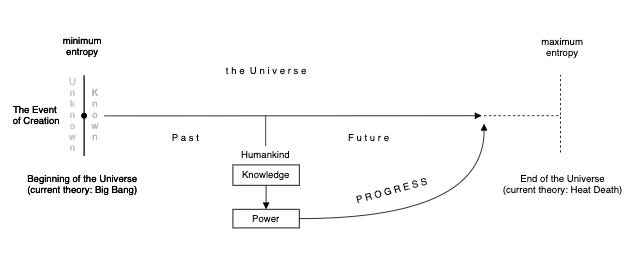
REVELATION - Progress
So the beings began the Work.
They would not be the slaves of stars
nor the prisoners of fate.
They would break the chains of death laid on them,
and “joy would be the fruit of their freedom.”57
No longer would they ask
“To what day is the doom fixed?”58
for they answered: “Never.”
No “single day will bring Destruction.”59
No end of days will come.
They would be not “be buried beneath
the debris of a Universe in ruins,”60
in “a colossal wreck, boundless and bare.”61
Their work would be of such that
“when they say ‘Be…’ it is,”62
and they would “uphold the Universe
by the word of their power.”63
Their “splendor would cover the heavens,”64
“dominion and awe would belong to them, and
they would establish order in the heights of heaven.”65
They would make “one city of the Universe.”66
For if one day the stars ceased
to fill the Universe with light,
the light of their being
would take their place.67
And with progress, purpose.
So the people of Earth gathered themselves into a civilization and called it humankind. They learned how the world worked and turned their knowledge into power. They subdued the land and tamed the wilderness around them. They harnessed the forces of nature and shaped the matter of the Earth to their will. And by shaping the world to their imagination, they became creators themselves. Among the wilderness of the world, they built a Dominion of Joy upon the land and established a home for humankind. Then they made a covenant with the generations, for they would not let what began in the beginning end as nothing. They passed civilization to their children, and the generations continued the progress of humankind. They increased their knowledge and power and did greater marvels than before. And in time, they spread across the face of the Earth and made the entire planet their homeworld. Their work seemed done and their covenant fulfilled. Now, they thought, they could rest. But they had only conquered a faraway world amongst an infinite wilderness. There was more work for them to do. So the humans looked to the stars above them and searched for their next task. And there they saw their doom: the Universe was dying, and they would die too.
At first, the humans were humbled by this.
They lowered their eyes from the stars above to the earth below.
And there, they looked upon the faces of those they loved, the gardens they planted, and the monuments they built. They looked upon the sunsets and storms and seasons of the world.
They listened to the laughter of their children, the music of their cities, the songs of their churches and stadiums. They listened to the bird-calls and thunder-claps and flowing-streams of the world.
They smelled the fruits they grew, the flowers they bloomed, the friends they hugged. They smelled the summer-grass and spring-air and ocean-mist of the world.
They tasted the bread they made, the wines they mixed, the feasts they prepared. They tasted the waters and meats and plants of the world.
They felt the warmth of a kiss, the touch of a hand, the love of another. They felt the sunlight and rain and wind of the world.
They imagined the future—the stories to be written, the songs to be sung, the art to be made. They imagined the memories they would cherish, the holidays they would celebrate, the life they would live. They imagined the children they would have, who they would become, the wonders they would do. They imagined raising monuments on the Moon, building cities throughout the stars, turning planets into gardens, and revealing the secrets of the Universe. They imagined the many worlds they would design: the streams they would carve, the forests they would plant, the fields they would lay, and the mountains they would lift. They imagined weaving stars into constellations, setting off fireworks made of supernova, and painting the infinity of space with the colors of a sunset.
And they remembered the past—the oceans and the lands, the storms and the animals, the deserts and the clouds, the valleys and the rivers. They remembered the tornadoes and the hurricanes, the floods and the earthquakes, the droughts and the wildfires. They remembered quiet mornings and warm nights, calm winds and clear skies, long summers and short winters, bountiful harvests and cheerful games. They remembered times of war and times of peace, blood spilled and blood given, lives lost and lives saved. They remembered hiking mountains and biking streets, visiting old cities and building new ones, walking through green forests and laying in golden fields. They remembered the best of times and the worst of times:68 dancing in weddings and weeping at funerals, celebrating birthdays and suffering pain—the anger and the sorrow, the laughter and the joy. They remembered the days of their youth and their dreams for the future. And they remembered the cemeteries of their parents and the nurseries of their newborns.
This, and far more, was their home.
So the humans raised their eyes to the stars again.
And they knew what they would do. They would do what they had always done.
Death would not be their destiny. Their home would not be erased from the existence of things forever. Creation would not be for nothing.
They would protect the life and love of their people by battling the blind rage of a dying Universe.
Now the humans made their choice.
They would save Creation.
EXODUS - Purpose
In the beginning, “ “ created the Universe.
In the end, humankind would save it.
So the Earthborn made their covenant with the Universe: because they loved Creation, they would rebel against it.69 They would free themselves from the fate of the stars and strike off the chains that nature laid on them. They would be slaves to none.
In search of a new promised land, the Earthborn would leave their home and go forth into the wilderness of the Universe. And as they ventured into the infinite unknown, they would face powers far greater than anything they had faced before. But by summoning the best of what made them human—their faith in themselves, their belief in the future, their love for each other—they would endure and go on.70 When nature’s power made them feel weak, their covenant would strengthen them. When the darkness of the Universe filled them with fear, the ever-bond of love would comfort them. When the work seemed too difficult and the way forward impossible, the old promise of hope would guide them.71
To save Creation, they would need to acquire the knowledge and power of salvation—to form strategems across spacetime, traverse the battlefields of galaxies, wield the cores of stars, and harness the forces of nature.72
And until then, the Universe would sit in judgment of them.73 Their progress would be the measure of their being, their dominion the example of their strength, their joy the testament of their life.74
In their struggle for freedom against the Universe, the Earthborn would go to war with the way of things. In their quest for peace, “they would bring not peace, but a sword,” for there would be “destruction and battles before them” in the days to come.75 And as the trials of their becoming progressed, the wilderness of the Universe would throw multitudes of annihilating-rage at them. In time, many battles would come to pass between the Universe and humankind:
The weather of the Earth would become violent and humans would live among chaotic seasons.76 A supervolcano would erupt and spew fire and ash across the world.77 An asteroid would strike the Earth and raze the life upon the land.78 Another asteroid would follow, this time larger and more disastrous.79 An ice age would come and the world would freeze.80 A neighboring star would explode and shower the Earth with a plague of radiation.81 The light of the Sun would become too bright and burn life away.82 The Sun would grow old and fade, and the world would become a wasteland in its shade.83 Our galaxy would collide with another and the Solar System would be broken asunder.84 The Sun would reach its dying days and the Earth would be destroyed in the lashing of its death throes.85 The expanse of the Universe would become too great for light to travel across and the sky would become a blanket of darkness.86 The last star would be born87 and the last star would extinguish.88 The end of all things would come, the Universe would be reduced to ruin, and Creation would be destroyed.
Unless.
Unless humans chose a different fate. Unless the people of Earth chose to advance throughout the stars. Unless each generation said: “Mine will not be the last” and “Life will be everlasting.” Unless generation after generation upheld the covenant, proclaimed the promise of hope, and continued the progress of humankind. Unless the descendants of Creation became the ascendants of Salvation—then the Universe would not be destroyed.
Atoms came together to form planets, planets to form galaxies, and galaxies the Universe. Humans would also come together, and together they would form the meaning of it all. Their knowledge and power would reach across the expanding deep, and their Dominion of Joy would fill the emptiness of space. The Earthborn would journey into the wilderness and, in their wake, they would spread the colors of their life and love throughout the darkness of the Universe.
Each time they faced a new trial, a new battle, a new enemy, they would arm themselves with the best of their humanity. They would think of all that came before and was still to come and they would sing the anthem of their cause: “Our struggle is not against flesh and blood, but against the authority and forces of darkness, against the cosmic powers of destruction, against the rule of evil in heavenly places. Let us take up the whole armor of our being, that we may be able to withstand evil and stand firm. Let us stand together fastened with the belt of truth, and with the breastplate of love, and as shoes for our feet, the gospel of peace. In all times of challenge, let us take up the shield of hope and extinguish the flaming arrows of death. Let us arm ourselves with the crown of our mind and the sword of creation.”89
And by this, they would conquer.90
Battle would follow battle. Victory would follow victory. Humans would come to know the wonders of the Universe and together they would meet them with their own. And in time, the progress of humankind would reach the ultimate test, and life would face the greatest trial of its being.
Then the Great War of the Universe would come.
It was determined long ago that Creation would one day come to an end. That the powers of destruction in the Universe would seem unstoppable. That life, although beautiful, would be fleeting. That what began in the beginning would end as nothing.
But by the grace of some holy unknown, we are here.
Since our beginning, we have looked to the stars and wondered. Yet we always bring our eyes down to Earth to look upon the faces of those we love, because no matter how far we venture into the stars, we will always return home, for there is among us something far greater than anything in the Universe.
We are endowed with gifts at birth, and by them, we are born to do something more than merely survive. We are crowned with a mind and anointed with reason. We are kissed by the fire of imagination and joined together by a love beyond time. We have settled the land and tamed the animals, built great machines to do our work and harnessed greater stores of energy to power them. We have raised monuments to worship Creation and escaped the hold of gravity to explore it. We have created things that have never existed before in the Universe: things like Goodness, Beauty, Truth, and Love. These are treasures that can be found nowhere else in the infinite expanse of space, except on this small and faraway planet called Earth—with us.91
We are creators. We shape Creation to our will. We gather the waters and clouds and dust of the earth; harness the winds and waves and wavelengths; wield light and gravity and atoms, all so that we can command our imagination upon the world with the power of our work.
We are the only ones who can remember the past and imagine the future. The only ones who can see the world as it is and imagine what it could be.92 We are blessed to know the beauty of the Universe, and cursed to know its end.
We are born as the stewards of civilization, but in time, we must become the shepherds of salvation. By liberating the life of the Universe, we must also craft its fate, because it is only by the progress of our creative power that salvation will come; only through us that the sonorous glory, the majestic splendor, the awesome wonder of Creation will remain.93
It is the blessing and burden of our being that we are free. Free to choose what we will become. To be either hell-bent or heaven-bound.94 We are “called to be free,”95 and so each of us has a choice to make in our days, a choice between “life and death, good and evil, the blessing and the curse.”96 Will we uphold the work of generations or abandon it? Proclaim hope or despair it? Fulfill the covenant or fail it?
If we fail, then all will be for nothing. Our children will one day be slaughtered and humankind will become extinct.97 Our work will be erased from existence, our home reduced to ash, and our love made a thing to be laughed at. Not even a memory of us will remain. Nothing will.
But if we succeed—which we must—then we can go on as we have. We can continue working towards a greater good, striving towards a greater end, moving towards a better day.
And we can live.
The Great War of the Universe will come. Of that, we have no choice. But we can choose to spend our days preparing ourselves so that, when the day comes, we can stand atop a world of our own making and face the doom written long ago with the “strength and good courage” of beings creators with a covenant.98
At the end of time, we shall command,"This is good!” and save all that is. And thereafter eternity will begin.
In the beginning, the Universe was made with a Word of Creation.99
In the end, it will be saved with a song.
A song of “love which moves the sun and the stars.”100
A Song of Creation.
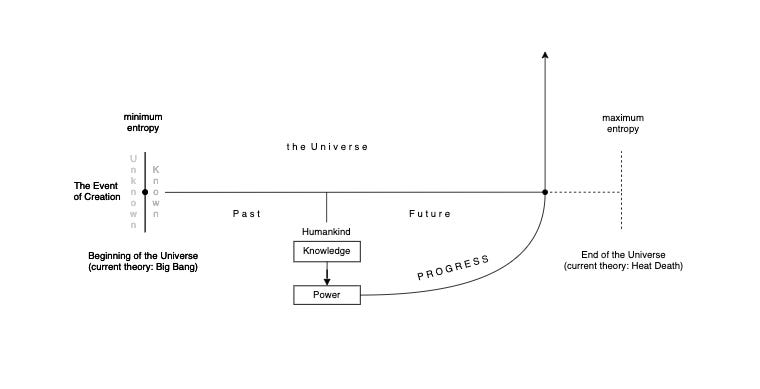
EPILOGUE:
So this is the aim of our efforts.
The direction of our progress.
The purpose of our being.
We are life, yes, and so we must survive.
But we are different.
We must also live.
The purpose of humankind may be to save Creation,
but it is the purpose of each of us to make it worth saving.
That is what it means to live:
to give life meaning.
So let us go forth.
Live fully and love deeply.
Gather us closer together.
Raise us to greater heights.
Bring us to better days.
Have children. Create wonders. Spread hope.
We have a Universe to save.
Or rather, the end of the habitability of the Universe for life. The Universe will go on after its “death,” since matter in its fundamental form will still exist after all things break down trillions of years from now, but we will not. Unless…(see below and the rest of the essay)
For the sake of clarity, I use the Heat Death/Big Freeze scenario as the likely end of the Universe throughout the essay, since the knowledge of my time weighs most in its favor. So, when describing the end of the Universe, I use Heat Death-related events like the death of starlight, the crumbling of matter, maximum entropy, et cetera.
I am aware that the Universe could possibly end in another scenario like the Big Crunch or Big Rip or Big Whatever, or that a future discovery in physics could reform our view of cosmology entirely (although it is unlikely given the success of the standard model of particle physics). However, although a future discovery might finally explain what dark energy or the cosmological constant is and change our eschatology, and although some rare quantum phenomena may just one day decide to upend our notion of reality altogether, I trust that the reader will understand the main point that I am trying get across:
The Universe will end in the future, some way or another—at least for us anyway.
As the Roman emperor Marcus Aurelius wrote, “Whatever happens to us has been waiting to happen since the beginning of time.” Whatever fate of the Universe may ultimately come to pass, none will be kind to us.
—
To be read only after finishing the entire essay above:
The full statement would then be, “The Universe will end in the future, some way or another, if we do not save it.”
How? The ultimate goal is for humankind is to live forever. We know that the natural increase of entropy will result in the end of the Universe. Therefore, we must try to discover how to decrease the entropy of the Universe. If we cannot, and if we are to survive, then we must find another way. And I have hope that we will, because we always have.
Thus, the Anthroteloeschacosmological Principle—the purpose of humankind from the end of the Universe: immortal life in infinite eternity.
And a prayer:
The Universe will end
and I will die
if today I do nothing
to save starlight
and humankind.
Baruch Spinoza, who quoted other ‘sages’ of religion.
“Someone who does not know that there is an ordered universe does not know where he is. Someone who does not know the natural purpose of the universe does not know who he is or what the universe is. Someone who fails in any one of these ways could not tell the purpose of his own existence either. So what do you think of the man who fears or counts the applause of an audience who have no idea where they are or who they are?” wrote Aurelius in his Meditations.
Story of Civilization, Volume VII, Will & Ariel Durant, p. 638
“By doubting we come to inquiry, and by inquiry, we receive the truth.” the 12th century AD/CE medieval philosopher Peter Abelard said.
Story of Civilization, Volume VII, Will & Ariel Durant, p. 638
Story of Civilization, Volume VI, Will & Ariel Durant, p. 246: “Though the age of the system-makers had passed…” referring to the work of ancient Greek philosophers who built wholesome programs for life, made entire systems of thought, and crafted comprehensive frameworks of knowledge in the effort to understand the cosmos and our place in it. Compare this to modern philosophers who argue over scholastic pedantry, semantic peddling, and obscure logic.
Perhaps the Greek historian Thucydides was right when he said, “The society that separates its scholars from its warriors will have its thinking done by cowards and its fighting by fools.” Philosophers have no courage these days.
“We should study philosophy, not for the ‘thorny quiddities of logic,’ but that which teaches us how to live...what it is to know, and not to know.” as the philosopher Michel de Montaigne wrote.
—
To be read after learning about the claim by some scientists and philosophers that the Universe will inevitably end according to some natural process of decay or collapse:
The philosopher-mathematician Bertrand Russell wrote “that all the labours of the ages, all the devotion, all the inspiration, all the noonday brightness of human genius, are destined to extinction in the vast death of the solar system, and that the whole temple of Man’s achievement must inevitably be buried beneath the débris of a universe in ruins. . . .Only within the scaffolding of these truths, only on the firm foundation of unyielding despair, can the soul’s habitation henceforth be safely built. . . .all these things, if not quite beyond dispute, are yet so nearly certain, that no philosophy which rejects them can hope to stand.”
Try me.
“All the world’s a stage…” As You Like It, Act II, Scene VII, William Shakespeare
The reader will notice a general theme and many references to the Bible. I do this for a reason.
I use the biblical explanatory structure of cosmology (the structure of the Bible as a story which explains the creation of the Universe, the creation of humankind, a story of the human condition, a way of living, the meaning of life, the purpose of life, the goal of history, and the end of the all things) not because I intend to substantiate the claims of the Bible or mock it, but because more than half of the world of my time believes in the Abrahamic faith (Judaism, Christianity, and Islam) and around 85% of humankind believes in some higher thing/power/truth/meaning/divine-unknown (including those who believe in Simulation Theory, which is oddly essentially the same thing as the intelligent designer of the old religions that they claim dispute). Throughout most of the last 2,000 years, the Bible has been the primary shaping-force of the world. That much is undeniable. Because of this, the biblical explanatory structure is not only deeply embedded in the minds and hearts of humankind, it also has significant social momentum in how humans approaches life, the Universe, and everything else. I do not think I have mustered a force large enough to halt such immense momentum, nor do I have enough time to chip away at it (if that were my goal, which it is not). It is here to stay, so I have joined with it.
To abandon the cultural and intellectual heritage of the Bible would be idiotic. Yes, its literal claims can be scientifically disputed, but we must acknowledge that the knowledge of the time it was written was not the same as ours. Yes, some things are outlandish, but can we claim that our society is void of outlandishness, that future generations will not look at our way of life and think it lacking? We must be humble when we receive the inheritance of the past.
The Bible is a part of us, whether we like it or not. We do not have to read it literally or follow it faithfully, but we can respect it, learn from it, and cherish it in our own way, whether deeply or not at all. By far, it is still the most profound work of wisdom that humans have yet produced. It represents the collective wisdom of thousands of years of human history, is a bonding agent between countless generations, and, most importantly, is a fundamental distillation of the human condition.
So, yes, I harness the momentum of the Bible’s explanatory structure of cosmology so my ideas can more easily reach the minds and hearts of the world.
I use the Bible here because it is a part of us.
The Guide for the Perplexed, Introduction, Maimonides
“ ” is the Event of Creation, before which is the Great Unknown. The knowledge of my time cannot describe it yet, so I leave the space blank for future generations to fill.
I like comparing this unknown name to the name of God in Judaism, YHWH, which is unspoken among its worshippers because its true pronunciation has been lost over the ages and therefore the true name is unknown. This God-like event of creation is unknown to us, and therefore cannot be named.
Genesis 32:29: “Jacob said, ‘Please tell me your name.’ But he replied, ‘Why do you ask my name?’”
Judges 13:18: “The angel said to him, “You must not ask for my name; it is unknowable!””
“God himself, the father and fashioner of all that is, older than the sun or the sky, greater than time and eternity and all the flow of being, is unnamable by any lawgiver, unutterable by any voice…” wrote Maximus of Tyre.
“Each person, according to his upbringing, gives the Supreme Being a name, but in reality to name the Unknowable is vain,” said Akbar, one of the greatest Emperors of India.
And we might never will.
Is there a fundamental limit to human knowledge about the Universe? Theoretical physicist Max Planck said, “Science cannot solve the ultimate mystery of nature. And that is because we ourselves are a part of nature and therefore part of the mystery that we are trying to solve.”
Similarly, are the two questions “How was the Universe created?” and “What is consciousness?” the same? Wouldn’t a mind finally understanding its true nature also be the Universe becoming truly self-aware? Physicist Brian Pippard once said, “What is surely impossible is that a theoretical physicist, given unlimited computing power, should deduce from the laws of nature that a certain complex structure is aware of its own existence.”
Perhaps, perhaps not; an interesting thought nonetheless. The better belief, in my opinion, is that we will one day learn the “ultimate mystery” of nature and consciousness, and go on learning afterward. Do I have a basis for this belief? No.
I await the day religion is considered not the antithesis of science but its other half. I yearn for a religion built upon a foundation of science, one that carries the old grandeur and majesty that built cathedrals and inspired our greatest scientists like Galileo, Newton, and Einstein to learn about Creation, one that gives to science what only we humans can: beauty and meaning. Science, as philosopher Immanuel Kant said, is organized knowledge. Religion, then, is organized wisdom, that wonderfully human thing. Must we be without a common creed, bound only by scientific truth without the unscientific human wisdom?
“Science discovers what is, but not what should be” as the theoretical physicist Albert Einstein said. Surely we can build a common religion of humankind. If engineering is applied physics and politics is applied philosophy, religion should be our applied humanity. Our minds may be nurtured by the knowledge of science, but our hearts need the wisdom of religion.
Science does not fill our hearts, tell us how to live, nor answer the questions of meaning. And religion does not tell us of the workings of the Universe, arm us with knowledge and tools, nor fill our hungry curiosity. There is no science without religious guidance and no religion with scientific discovery. Both are the balance of life, the fire of knowledge and the guiding light of its wisdom. Prophets tell us the destiny of humankind and physicists the destiny of the Universe. Messiahs show us how to live in the world and mechanics how to live in the Universe. I dream of a day when the nations of civilization are filled with such messiah-mechanics and prophet-physicists. Let this not only be a dream.
More accurately: the scientific method. Too much in my time is “science” invoked as some mystical belief-system, comparable to, as well as the antithesis of, the religious belief systems of the past. Many appeal to science as an infallible authority and command us to “trust the science” and “believe the facts,” when the basic premise of science is to do the opposite: to distrust every scientific theory and try to disprove every scientific fact until we have a high enough (but never absolute) degree of confidence in our ability to describe the true nature of reality. There is no absolute trust or unwavering belief in science, there is only accumulating evidence and constant experiment.
Science is only a mental tool, a way of thinking—and the best one we have.
Origin of the idea of heat death: On a Universal Tendency in Nature to the Dissipation of Mechanical Energy, William Thomson, 1852. (Thomson conjectured the idea from the thermodynamic concepts formed in his time, the 19th century AD/CE, formally expressed in the works noted in footnote 20).
Spare me the physicist’s scorn. Yes, the “point” of origin might have been dimensionless and without either a location in space or duration in time, since perhaps neither existed at the moment of creation. The Big Bang was no ordinary explosion in the sense of stuff exploding outwards from a central point in space, since it is theorized that space itself was created by the explosion of the Big Bang, and therefore had no central point of origin. So, embrace my prosaic license. (An aside: I believe space and time existed before the Creation Event, because something cannot be created from nothing, and therefore something—i.e. space and time—existed before the creation of our Universe, since the internal time of the quantum/fundamental parts of the “stuff” of Universe, which theoretically were bunched together in infinite density at the beginning, would still exist, else they would not exist and hence there would be no “something” for a Universe to be created with.)
It is humbling to realize how young we still are. It was only a hundred years before I was born that we discovered, ah, this is how the Universe began! and…oh, this is how it will end. We are truly only just beginning.
Theory and mathematical basis: A Homogeneous Universe of Constant Mass and Increasing Radius accounting for the Radial Velocity of Extra-Galactic Nebulae, Georges Lemaître, 1927
Astronomical observation: A Relation Between Distance and Radial Velocity Among Extra-Galactic Nebulae, Edwin Hubble, 1929
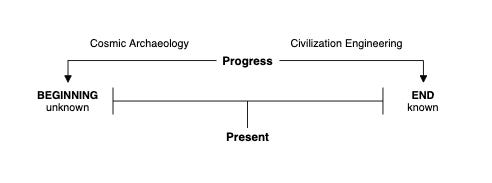
An Anatomy of the World, John Donne
Homilies on the Gospels, Pope Gregory I
Here I am referring to entropy, that mysterious concept which confuses experts and enlightens laypeople. In a nutshell, there is an infinite number of configurations of atoms that could make an ocean (high entropy), but only relatively few that could make a flower (low entropy).
Popularly, entropy is a measure of disorder or chaos in the Universe, so increasing entropy means increasing disorder/chaos. Minimum entropy is maximum order, maximum entropy is maximum disorder. So when I say ‘perfect order,’ I mean the minimum entropy of the Universe, or the minimum number of possible states of matter that could make up a macroscopically emergent system of order.
Scientifically…the definition is not so simple. There is debate about what the true definition of entropy is, or rather should be; such as whether it should only be a statistical representation of the measure of information in a system, whether a value for the entropy of the Universe can truly be defined and therefore measured, whether the Universe is an isolated or open system, and so on. I am blatantly ignoring all of this because the popular definition of entropy is useful when trying to broadly explain the speculative evolution of the Universe. Condemn me if you must ye puritans.
So for the purpose of this essay, I use this more metaphoric definition of entropy: the loose association between entropy as a probabilistic description of various microstate configurations of emergent macroscopic observations in thermodynamic systems, and entropy as a conceptual generalization of order and disorder. As biologist E.O. Wilson said, “the more advanced a civilization, the more elaborate its metaphors” and, according to scientist Vaclav Smil, “the second law of thermodynamics…[is] perhaps the grandest of all cosmic generalizations.” So let us simplify the complexity and use this grand cosmic generalization as a metaphor so we can better visualize and understand the origin and fate of the Universe.
“Verily at first Chaos came to be,” wrote the 8th century BC Greek poet Hesiod in his Theogony.
In today’s terms, this would be the maximum entropy of the Universe as described in the Heat Death/Big Freeze scenario.
In extremely basic and very simple terms, the first law of thermodynamics states: the energy of the Universe (the sum of potential energy (unused energy), kinetic energy (energy in use), and waste heat (used energy)) is constant. It can be changed into many forms, but it cannot be created or destroyed. The second law of thermodynamics states: as the Universe changes over time, the amount of useful energy (energy that can be used for work (work being the use of energy and matter to do something, or the application of force over a distance)) decreases over time, because, during work, some useful energy is lost from friction, when useful energy is changed into thermal energy that is useless (waste heat) — hence the efficiency of a work-process is measured as the potential energy before work is done divided by the amount of energy used after. A perfect efficiency, meaning no lost heat, would equal one. Therefore, the entropy of the Universe increases over time (because there is less and less useful energy to do the work that maintains and creates order).
In other words, “every form of energy can be turned into heat, or thermal energy. No energy is ever lost in any of these conversions. Conservation of energy, the first law of thermodynamics, is one of the most fundamental universal realities. But as we move along conversion chains, the potential for useful work steadily diminishes. This inexorable reality defines the second law of thermodynamics, and entropy is the measure associated with this loss of useful energy. While all energy content of the universe is constant, conversions of energy increase its entropy and decrease its utility.” (Energy and Civilization, Vaclav Smil, p. 8)
The order of the Universe (stars, planets, galaxies, life, etc.) is made by work. As the order of the Universe uses energy over time, the amount of useful energy needed to do work decreases over time, so less order can be made and maintained over time; therefore, the disorder of the Universe increases over time. The disorder of the Universe will increase until there is no useful energy left in the Universe for work to be done, so the disorder of the Universe will increase towards a maximum — when there is no useful energy left to do work; and therefore no order left in the Universe.
Hence, “the entropy of the Universe tends toward maximum,” as one of the fathers of thermodynamics, Rudolf Clausius, said. Over time, less and less energy can create and maintain the order of the Universe, so the Universe generally decays over time. Eventually, there will be no order left and Creation will be nothing…macroscopically, that is.
The measure: On the Relationship between the Second Fundamental Theorem of the Mechanical Theory of Heat and Probability Calculations Regarding the Conditions for Thermal Equilibrium, Ludwig Boltzmann, 1877.
The law: Concerning Several Conveniently Applicable Forms for the Main Equations of the Mechanical Heat Theory, Rudolf Clausius, 1865.
Genesis 3:19 (variation)
The early Universe was a formless cloud of particles until two small lovers joined together and gave birth to the attraction of things (gravity). Once gravity took hold, it began to sculpt That Which Now Is.
Genesis 1:2 (variation)
Antigone, Sophocles; variation
Genesis 1:3 (variation)
Exploring the Earth and the Cosmos, Isaac Asimov, p. 176
Fragments of Chaldean History, Berossus
Exodus 3:14
Discourse on Method, Rene Descartes
Genesis 1:28
A combination of verses — Isaiah 22:13, Ecclesiastes 8:15, 1 Corinthians 8:15, Luke 12:19.
“Build houses and dwell in them, and plant gardens, and eat the fruit of them; takes partners and beget sons and daughters.” Jeremiah 29:5, variation.
Also, I am going to here ward off any accusations that I imply the meaning of life is Epicurian or Hedonistic; that pleasure is all and nothing else. No. I use this supremely generic verse in order to communicate general ideals that we all, I hope, agree on: living a good life, accepting there can be no good without the bad, striving towards a greater good, working towards a greater end, being content with life with all its trials and triumphs, persevering through struggle, finding happiness, spreading it, et cetera.
The Death of Gilgamesh, translation by Antoine Cavigneaux and Farouk Al-Rawi, line 152
John 1:1
Also a variation of Durant’s opening line to p. 72 of his Story of Civilization, Volume I
Civilization: the general system and active force of human-made order in the Universe.
“Men lacked all tools and all crafts in the early years. The earth no longer supplied their food spontaneously and they did not know how to win it for themselves.” Plato wrote in his The Laws
This is akin to the relationship between knowledge and power (applied knowledge): physics is knowledge about how the world works and engineering applies that knowledge to build and create. So, engineering is applied physics. We learn physics — how the Universe works — and then we use that knowledge in the real world, which is engineering.
In the division of knowledge between the Universe and humankind, physics/engineering is the knowledge-domain of the Universe, whereas philosophy/government (where philosophy is everything other than physics and government is applied philosophy) is the knowledge-domain of humankind.
“Human muscles were the only source of mechanical energy from the beginning of hominin evolution until the domestication of draft animals, which started only about 10,000 years ago.” (Energy & Civilization, Vaclav Smil, p. 389) The “domestication of animals multiplied kinetic energies under human control,” (Grand Transitions, Smil, p. 126) and “human power was increased by using a growing number of better tools.” (E & C, p. 389) After all, humans are “tool-making animals,” as scientist-statesman Benjamin Franklin said.
“As long as human, and later animal, muscles remained the only prime movers, all labor rates were determined by metabolic imperatives: by the digestion of food and feed, by the basal metabolic and growth requirements of homothermic bodies, and by the mechanical efficiency of muscles.” (E & C, p. 419) “Speeds of walking and running are, of course, fundamentally constrained by the forms of human and animal bodies and by the maximum rate of their metabolism.” (Growth, Smil, p. 267) So “only a massing of people or draft animals could overcome these limits and, as attested by prehistoric and ancient monumental structures, such feats, requiring effective, coordinated control, were repeatedly accomplished.” (E & C, p. 419)
Due to this, “nearly all fundamental variables of premodern life—be they population totals, town sites, longevities and literacy, animal herds, household possessions, and capacities of commonly used machines—grew at such slow rates that their progress was evident only in a very long-term perspective.” (Growth, p. xi) [This relates to footnote 75 below about how the ancient Greeks couldn’t truly form the idea of human progress given how little history they had behind them]
“The amount of energy at a society’s disposal puts clear limits on the overall scope of action…dominant fuels and prime movers are among the most important factors shaping a society.” (E & C, p. 431) “Past adoptions of new energy sources and new prime movers could never have had such far-reaching consequences without introducing and perfecting new modes of harnessing those energies and controlling their conversion to supply required energy services (heat, light, motion) at desirable rates.” (E & C, p. 425)
Considering this, “substantial investment is needed to develop the extensive infrastructure needed to extract (or transmit) fuels and electricity, to process fuels, and to mass-manufacture new prime movers. In turn, the introduction of these new sources and prime movers elicits clusters of gradual improvements and fundamental technical innovations.” (E & C, p. 410) In other words: they elicit progress.
“Energy’s fundamental role in economic growth is obvious: all productive activities require its conversions.” (Growth, p. 426) “Civilization’s advances can be seen as a quest for higher energy use required to produce food harvests, to mobilize a greater output and variety of materials, to produce more, and more diverse, goods, to enable higher mobility, and to create access to a virtually unlimited amount of information. These accomplishments have resulted in larger populations organized with greater social complexity into nation-states and supranational collectives, and enjoying a higher quality of life.
This uniformity also imposes many identical, or very similar, imprints not only on crop cultivation (leading to the dominance of a few commercial crops and the mass production of animal foods), industrial activities (entailing specialization, concentration, and automation), the organization of cities (leading to the rise of downtown business districts, suburbanization, and subsequently the desirability of green spaces), and transportation arrangements (in large cities manifesting as the need for subways, suburban trains, commuting by car, and taxi fleets) but also on consumption patterns, leisure activities, and intangible aspirations.” (E & C, p. 386)
—
One way of describing the civilizational phase transition from the Ancient (aren’t we the true ancient ones though, older than those that came before?) to the Modern is the change from using animate prime movers (muscles and animals) and biomass fuels (wood, various carbon-based materials, animal waste) to do work, to using inanimate prime movers (machines) and fossil fuels and electricity to do work (as discussed in E & C, p. 388). In other words, the phase transition of human civilization from the Ancient to the Modern was about doing more with less — increasing the efficiency ratio of our work, increasing the capacity of our tools, harnessing greater sources of energy and improving our stores of it, so that we can do work on a larger scale.
I would be remissed if I did not mention here a similar but broader framework of civilization that astronomer Nikolai Kardashev made: the Kardashev scale, which rates a civilization’s level of power by measuring the total amount of energy it can control and use. It ranks a civilization in increasing levels: from the using the sum energy of a planet, to a solar system, to a galaxy, and finally to the Universe (if the multi-verse does not exist, which then would be an additional level).
In addition to these basic necessities that lifeforms need to survive, early human civilizations included a few more basic needs and desires in their law codes.
In the preamble and concluding epilogue of the Code of Hammurabi, an 18th century B.C.E. law code, the Babylonians expressed the desire to “subdue the earth, bring prosperity to the land, [and] guarantee security to the inhabitants in their homes.” Compare this preamble of an 18th century B.C.E. law code with the preamble of the 18th century C.E. law-code of the United States of America: “[to] provide for the common defense, promote the general Welfare, and secure the Blessings of Liberty to ourselves and our Posterity.” They’re identical!
I find it remarkable that these foundations of law, and therefore of civilization itself, have remained almost unchanged after nearly four millennia of history. The laws of nature are constant, and the beauty of the cosmos builds around them, and it seems that the spiritual laws of humankind are also constant, and the beauty of our civilization builds around them.
The Enlightenment philosopher Nicolas de Condorcet wrote in his book, Historical Tableau of the Progress of the Human Mind, “In this state, it is apparent that the uncertainty and difficulty of procuring subsistence, and the unavoidable alternative of extreme fatigue or an absolute repose, leave not to man the leisure in which, by resigning himself to meditation, he might enrich his mind with new combinations.
…As the means of living become less dangerous and less precarious, population increases; agriculture, which can provide for a greater number of individuals upon the same space of ground, supplies the place of the other sources of subsistence; it favors the multiplication of the species, by which it is favored in its turn; in a society become more sedentary, more connected, more intimate, ideas that have been acquired communicate themselves more quickly, and are perpetuated with more certainty. And now the dawn of the sciences begins to appear; man exhibits an appearance distinct from the other classes of animals, and is no longer like them confined to an improvement purely individual.”
Only after all toil is spent can we have the time to sit down and think. The more we automate work, the more time, theoretically, we should have, and therefore, hopefully, more culture and technology should be produced.
Here also let us reminisce on a passage from a man who spoke of science in psalms, Carl Sagan in his Pale Blue Dot:
“We were wanderers from the beginning. We knew every stand of tree for a hundred miles. When the fruits or nuts were ripe, we were there. We followed the herds in their annual migrations. We rejoiced in fresh meat. through stealth, feint, ambush, and main-force assault, a few of us cooperating accomplished what many of us, each hunting alone, could not. We depended on one another. Making it on our own was as ludicrous to imagine as was settling down…
Working together, we protected our children from the lions and the hyenas. We taught them the skills they would need. And the tools. Then, as now, technology was the key to our survival.
When the drought was prolonged, or when an unsettling chill lingered in the summer air, our group moved on—sometimes to unknown lands. We sought a better place. And when we couldn't get on with the others in our little nomadic band, we left to find a more friendly bunch somewhere else. We could always begin again.
For 99.9 percent of the time since our species came to be, we were hunters and foragers, wanderers on the savannahs and the steppes. There were no border guards then, no customs officials. The frontier was everywhere. We were bound only by the Earth and the ocean and the sky.
When the climate was [comfortable], though, when the food was plentiful, we were willing to stay put. Unadventurous. Overweight. Careless. In the last ten thousand years—an instant in our long history— we've abandoned the nomadic fife. We've domesticated the plants and animals. Why chase the food when you can make it come to you?
For all its material advantages, the sedentary life has left us edgy, unfulfilled. Even after [thousands of] generations in villages and cities, we haven't forgotten. The open road still softly calls, like a nearly forgotten song of childhood. We invest in far-off places with a certain romance. This appeal has been crafted by natural selection as an essential element in our survival. Long summers, mild winters, rich harvests, plentiful game—none of them lasts forever. It is beyond our powers to predict the future. Catastrophic events have a way of sneaking up on us, of catching us unaware. Your own life [is] owed to a restless few—drawn, by a craving they can hardly articulate or understand, to undiscovered lands and new worlds.”
I am again using a metaphor here: the singular ‘city’ to represent the dominion and home of humankind, rather than attempt to historically recount the numerous city-settlements that the various geographically-dispersed proto-civilizations created separately from each other; such as those in Mesopotamia, Egypt, India, China, and Mesoamerica.
What’s interesting is that these groups of early humans, who were so distant from each other and without any contact between them, developed in the same basic ways towards civilization. So, while there may be no “law” to human history in the same way there are laws of nature, there is evidently something fundamental to humankind that enables it to inherently develop and, dare I say, progress in a certain universal way. Something for the cliodynamicists to explore.
Civilization, the anti-entropy algorithm of the Universe
Exodus 31:3
Epilogue of the Code of Hammurabi
An old Arab proverb
The Seven Lamps of Architecture, John Ruskin
In full: “When we build, let us think that we build forever. Let it not be for present delight nor for present use alone. Let it be such work as our descendants will thank us for; and let us think, as we lay stone on stone, that a time is to come when those stones will be held sacred because our hands have touched them, and that men will say, as they look upon the labor and wrought substance of them, 'See! This our fathers did for us.”
Amidst “the birth of the universe, the light of the heavens, the infinity of the cosmos, the profundity of space,” (Redemption of Time, Baoshu) “here you learn what it is to be human. You are a creator of order, of beautiful shapes and systems, an organizer of chaos.” (Heretics of Dune, Frank Herbert)
The Egyptians and the Greeks, the Romans and the Europeans, the Indians and the Chinese, the Americans and the world—they all wanted to become eternal, and so they built.
We must build also.
Cities and Thrones and Powers, Rudyard Kipling
Psalms 145:13 (variation)
“The time will come when diligent research over long periods will bring to light things which now lie hidden. A single lifetime devoted entirely to the sky would not be enough to investigate so vast a subject...And so this knowledge will be unfolded through long successive ages. There will come a time when our descendants will be amazed that we did not know things so plain to them...Let us be satisfied with what we have discovered, and let our descendants also contribute something to the truth...Many discoveries are reserved for ages still to come…” the Roman philosopher Seneca the Younger wrote in his Natural Questions in 65 BC.
“No one is able to attain the truth adequately, while on the other hand, we do not collectively fail; but each one says something true about the nature of things, and while individually we contribute little or nothing to the truth, by all of us together, a considerable amount is amassed.” the Greek philosopher Aristotle wrote in his Metaphysics in the fifth century BC.
“Let us create vessels and sails adjusted to the heavenly aether, and there will be plenty of people unafraid of the empty wastes. In the meantime, we shall prepare for the brave sky-travelers, the maps of the celestial bodies.” astronomer Johannes Kepler wrote in a letter to fellow astronomer Galileo Galilei in the 17th century AD/CE.
We stand on the shoulders of giants as the scientist Isaac Newton said. We must be pioneers who bravely trek the wild frontier of the unknown to prepare the way for future generations.
Genesis 17:7: “I will establish my covenant between me and you and your offspring after you throughout their generations…”
Here I am indebted to the work of Jewish Rabbi Jonathan Sacks in his biblical commentary “The Genesis of Love.”
There are two aspects of our humanity (humanity being to humankind what personality is to a person): the majestic and the covenantal. The majestic comes from being masters of creation, the covenantal from being seekers of love. We create, as does the Universe, but we uniquely do so out of love. In the Abrahamic tradition, humans are said to be made from both the dust of the earth (the body) and the breath of God (the mind). Being made from “the dust of the earth” makes us a part of Creation, but having “the breath of God” sets us apart from the rest of things because we are self-aware and have consciousness (or whatever you call that unique blessing in our mind) and therefore are endowed with responsibility, morality, creativity, and the like.
A combination and variation of Ezekiel 37:26 and Jeremiah 32:40.
In other words: “A partnership not only between those who are living, but between those who are living, those who are dead, and those who are to be born.” as philosopher-statesman Edmund Burke wrote in his Reflections on the Revolution in France.
“How blessed is he who his progenitors
with pride remembers, to the listener tells
the story of their greatness, of their deeds,
and, silently rejoicing, sees himself
the latest link of this illustrious chain?”
(Iphigenia in Tauris, Johann Wolfgang von Goethe)
-
“I the heir of all ages.” (Locksley Hall, Alfred Tennyson)
Our explorations in space will shame even the greatest explorers of the Age of Discovery, and there will be many more Columbuses and Magellans and Polos in the days to come. We will master earth’s orbit and the moon, then Mars and the other planets, then the asteroid belt, then Andromeda, and then further into intergalactic space. We will surpass the navigators of old who charted new oceans, mapped new lands, discovered a new world, and explored new frontiers. How can they compare to the future generations who will steer the very stars themselves onto new orbits?
Exodus 34:10
From a letter written in 1911 by Antonin Tsiolkovsky, a founding father of rocketry and space travel
I am reminded of a quote from Plutarch’s Moralia. He describes the Macedonian emperor Alexander the Great contemplating the infinity of the Universe:
“When Alexander heard from the philosopher Anaxarchus that there was an infinite number of worlds in the Universe, he wept; and when his friends asked him what was wrong, he replied: Is it not a matter of tears that, when the number of worlds is infinite, I have not yet conquered one?”
The Funeral Oration of Pericles, the leader of Athens during its Golden Age, as recounted in Thucydides’ history of the Peloponnesian War
Quran 77:12 (variation)
On the Nature of Things, Lucretius
Why I Am Not a Christian, Bertrand Russell
Ozymandias, Percey B. Shelley
Quran 6:73 (variation)
Hebrews 1:3 (variation)
Habbakuk 3:3 (variation)
Job 25:2 (variation)
Annus Mirabilis, John Dryden
“As it was in the beginning, is now and ever shall be, a world without end.” The Latin version of the Christian hymn Gloria Patri.
A gratuitous use of the overused opening line of Charles Dickens’ A Tale of Two Cities.
John 3:16 (inspiration)
Faith: through faith “all things are possible” (Matthew 19:26) and “nothing is impossible” (Luke 1:37)
There are two rules in Creation: either something is “impossible, because it is forbidden by the laws of nature” or “possible, with the right knowledge and power.” (Beginning of Infinity, David Deutsch, p. 56)
Love: “The only thing that counts is faith [secular or religious] expressing itself through love.” (Galatians 5:6)
So “the foundation of the law is love.” (Galatians 5:14)
And here also is the Golden Rule: “Love your neighbor as yourself.” (Leviticus 19:18) “Do to others as you would have them do to you.” (Matthew 7:12)
“Far from being the pious injunction of a utopian dreamer, this command is an absolute necessity for the survival of our civilization. Yes, it is love that will save our world and our civilization, love even for our enemies.” Martin Luther King Jr. said in his sermon Loving Your Enemies.
For “there is within us what misfortune cannot steal away…” as Wen T’ien-hsian, a prisoner of the Mongol emperor Kublai Khan, said.
There is hope.
He would have liked the Stoics.
Still undetermined whether this means perfect knowledge and power (all-knowing and all-powerful) or only reaching a certain level of knowledge and power that would allow for salvation-like power over entropy, matter-decay, thermodynamic processes, and whatever other processes that are essential to the evolution of the Universe. I tend towards the latter, that salvation can be achieved without perfect knowledge, for reasons mentioned above in footnote 10.
So every day can be considered the Judgement Day of the Muslims. Every natural catastrophe that could wipe us out the Armageddon of the Christians. Any time that we fail to defend ourselves from extinction the End of Days of the Jews.
“Mene, mene, tekel, upharsin,” says Daniel 5:25. Very roughly translated, it means: “Your days were numbered and now are at their end. You have been weighed in the balance and found wanting.” This was the writing on the wall in the palace of the Babylonian King Belshazzar which the prophet Daniel interpreted to mean that God had judged the kingdom, found it inadequate to the standards of cosmic salvation, and therefore decided to destroy it as a punishment for its failure to become good and strong in the eyes of the Universe’s Creator and Destroyer.
“Man is the measure of all things,” the 5th century BC Greek philosopher Protagoras was quoted to have said in Plato’s Theaetetus
Matthew 10:34, variation. The religious leader Jesus is written to have said: “Do not think I have come to bring peace to the earth. I have not come to bring peace, but a sword.”
Habbakuk 1:3
For the sake of argument, let’s reframe how we measure historical time in order to better appreciate the time scale of these battles — mainly their imminence. Given that the earliest scientific evidence we have of anatomical humans is about 200,000 years old, and given that we measure our history as being 2,021 years after the death of the religious leader Jesus Christ, we can say that the scientific age of a religious humankind is around 202,021 years old.
So we are approximately 202,021 years old.
215,000 years after our birth (this new Year Zero), the axial tilt of Earth will likely reverse, causing the seasons of Earth to become chaotic and the weather violent.
So, we only have around 13,000 years left to prepare
For the following “battles against the Universe,” let us remember that these events are speculative, that we cannot know for sure when they will happen or as described. These are only the natural catastrophes that we know of, and therefore can conjecture about — we cannot imagine what we do not know. So who knows what Nature might throw at us and when. What we do know is that, at some point in the future, such annihilation-events will occur, some way or another.
As the Chinese war strategist Sun Tzu said, all warfare is based on deception. So we must be mindful of the attacks that nature hides from us, the battles that are unknown to us either how or where or when. “The supreme art of war is to subdue the enemy without fighting,” Tzu said — to win the war before it begins. The Universe may try to finish us off before we can even get our progress up and running to put up a good fight. If we are not humble enough to accept this, the Universe could be a David to our Goliath and kill us with a fling of a rock!
300,000 years after our birth, a supervolcano will likely explode on Earth.
So, we only have around 98,000 years left to prepare.
300,000 years after our birth, an asteroid will likely strike Earth.
So, we only have around 100,000 years to prepare.
700,000 years after our birth, a mega-asteroid will likely strike Earth.
So, we only have around 500,000 years to prepare.
700,000 years after our birth, a new ice age will likely occur.
So, we only have around 500,000 years to prepare.
10,000,000 years after our birth, a nearby star will likely go supernova, and shower earth in gamma radiation, causing mass extinction.
600,000,000 years after our birth, photosynthesis (C3) will likely end, and with it 99% of life on Earth.
1,000,000,000 years after our birth, the Sun will likely end.
4,000,000,000 years after our birth, the Milky Way galaxy and Andromeda galaxy will likely collide.
4,000,000,000 years after our birth, the Sun will likely expand as it dies, burning the Earth.
150,000,000,000 years after our birth, cosmic inflation will likely cause things to move away from each other faster than light can travel.
1,000,000,000,000 years after our birth, there will likely be no gas clouds left to form new stars.
110,000,000,000,000 years after our birth, the fuel of stars will likely extinguish, and with it, light.
Ephesians 6:12, a combination and variation of different translations from the original Greek
The phrase “By this, conquer” comes from a story about Roman-Byzantine emperor Constantine the Great. He saw the phrase in the sky as a ‘vision from God’ on the eve of a battle that would turn out to be pivotal for his reign. Constantine’s victory paved the way for him to assume total control of the Roman Empire, and with his strengthened power and vast territorial reach, he was able to spread a new religion, Christianity, across the land — and eventually the world.
Assuming, as the knowledge of my time forces me to do, that we are the only forms of life with such gifts.
“A pile of rocks ceases to be that the moment a single man contemplates it, becoming within him the image of a cathedral.” (The Little Prince, Antoine de Saint Exupery)
Throughout human history, there have been three views of the progress and purpose of humankind:
The ancient Greeks believed in Permanence. Given that they had only a little history behind them — and not much objective improvement in population, agriculture, knowledge, energy, or industry — it stands to reason that they viewed the future as somewhat constant. They also believed in fate written by the gods, that the future of the Universe was fixed, that only the gods had any influence on the way of things. They believed that the world used to be in a Golden Age from which humankind had fallen and was eternally degenerating away from. They believed they were capable of becoming better, yes, but in a limited way. As the Greek philosopher Xenophanes said, “the gods did not reveal to men all things from the beginning, but men, through their own search, find in the course of time that which is better” (I am here indebted to J.D. Bury’s The Idea of Progress and Robert Nisbet’s contrasting History of the Idea of Progress). The ancient Greeks believed humans could improve “little by little” (Plato) and “step by step” (Lucretius) “over the course of time” (Protagoras), but they certainly did not imagine that human progress was capable of achieving the scope and scale of civilizational improvement that has actually occurred and is still possible. So the possibility of progress-as-an-idea was prohibited.
Then Christians came with their belief in Providence. Similarly, they believed humankind had fallen from the perfection of a Garden of Eden and was damned to be sinful for the rest of history. Eventually, a divine being would save them and provide eternal life and safe-haven in an otherworldly city of Heaven, rather than saving themselves and building a city of their own making. So they believed that history was moving in a desirable direction towards a better future, yes, but they believed that humans had no influence in the destiny of things. They believed that faith in the future alone would bring about a better world, not through their own work. The heavenly end would be provided by another, not by their own hand. So the possibility of progress-as-an-idea was prohibited.
Then came the Modern idea of progress. With enough history behind us, we were able to observe that, yes, civilization has improved in objective measures and in a desirable direction. The idea of progress then came from the logical conjecture that this desirable movement could continue in the future. The phase-transition between the Ancient and the Modern happened sometime during the Middle Ages, after the revival and replenishment of civilization from the intellectual fruits and artistic labors of the Renaissance. In the 13th century AD/CE, the philosopher Roger Bacon planted the seeds that would lead to the Englightenment: “It is our duty to supply what the ancients have left incomplete, because we have entered into her labors, which, unless we are asses, can stimulate us to achieve better results.” Here also began the rebellious efforts to create a secular system of education, so that people could learn of their own accord and not be mind-controlled by the ideological tyranny of church and state. Then the philosopher Francis Bacon came in the 16th century AD/CE, who gave a great push to the momentum of the cause of progress. He worked to show that knowledge had utility, that it was not, like for the Greeks and the Christians, simply for intellectual or spiritual satisfaction, but for humankind to use in order to gain control over nature. He gave form to the scientific method, one of the greatest tools we have to learn about the Universe. “Man, being the servant and interpreter of Nature, can do and understand so much, and so much only, as he had observed, in fact or in thought, of the course of Nature; beyond this, he can neither know anything nor do anything…Human knowledge and human power meet in one; for where the cause is not known, the effect cannot be produced. Nature, to be commanded, must be obeyed” he wrote in his Novum Organum. And this would shape all history that came after, the prelude to our progress. Then the philosopher-scientist Rene Descartes came and established a universal science based on reason alone, to begin by doubting everything…a truly radical notion. He said: “Archimedes, in order that he might draw the terrestrial globe out of its place and transport it elsewhere, demanded that only one point should be fixed and immovable; in the same way I shall…discover one thing only which is certain and indisputable…Je pense, donc je suis.” Cogito, ergo sum. I think, therefore I am. Now knowledge would be enhanced and forthcoming by the collaboration and criticism of all people, not by the authority of any one. Many more such civilization-engineers came afterward, and we all know how the story goes, for their work built the world in which we now live. Our knowledge of the Universe increased, an industrial revolution was brought about, we split the atom, fed the world, cured diseases, and went to the Moon. Progress was established with a grand and dramatic entrance.
So the ancients were correct in their idea of Permanence, the Christians in their idea of Providence, and we in our idea of Progress:
The permanence of our life will be provided by our progress.
“The human race is what we wish to make it,” as the philosopher and cleric Guillaume-Thomas Raynal said. We can make “a heaven of hell, a hell of heaven” (Paradise Lost, Book I, line 255, John Milton) by what we choose with our minds. We create by our will by what we deem good, what we decide is the worthy direction of our efforts, the ultimate end to pursue. The choice we must make is for the direction of our progress to be towards the everlasting life and freedom of humankind, unbounded and unthreatened.
To quote the Renaissance philosopher Giovanni Pico della Mirandola’s Oration on the Dignity of Man, a change-making essay that elevated the idea of humanism, summarized the ideals of the Renaissance, and heralded the Enlightenment. He wrote a dialogue where God tells humankind what He has endowed them with: “We have given you, O Adam, no proper image of yourself, nor endowment properly your own, in order that whatever place, whatever form, whatever gifts you may, with premeditation, select, these same you may have and possess through your own judgment and decision…[that you] may, by your own free will…trace for yourself the lineaments of your own nature….We have made you a creature neither of heaven nor of earth, neither mortal nor immortal, in order that you may, as the free and proud shaper of your own being, fashion yourself in the form you may prefer. It will be in your power to descend to the lower, brutish forms of life; you will be able, through your own decision, to rise again to the superior orders whose life is divine…Upon man, at the moment of creation, God bestowed seeds pregnant will all possibilities.
Let some holy ambition invade our souls, so that, dissatisfied with mediocrity, we shall eagerly desire the highest things and shall toil with all our strength to obtain them, since we may if we wish.”
Since we may if we wish.
Galatians 5:13
Deuteronomy 30:15
And here is the absolute equality of every human being, each capable by themself to choose and act.
—
“Here, take this gift,
I was reserving it for some hero, speaker, or general,
one who should serve the good old cause, the great idea,
the progress and freedom of the race,
some brave confronter of despots, some daring rebel;
but I see that what I was reserving belongs to you
just as much as any.”
(To a Certain Cantatrice, American poet Walt Whitman)
—
I agree with Einstein’s objection to the current approach to quantum mechanics, that the nature of the fundamental parts of the Universe is ultimately random. I am a determinist. I believe there are laws of the fundamental particles, that we can know them, and that we can understand the entire Universe and predict its future, though not the future of humankind. For I believe that humans have free will, that is, unpredictable choice. I also believe mind is only matter—the bare fact of existence is miraculous enough, I do not need to heap more miracles upon it by claiming that the mind is mysteriously more than matter. Consequently, I do not think it is a paradox for me to claim that the source of our free will, our consciousness (or intelligence or self-awareness or sentience or metacognition or mind, whatever you want to call it—That Which Makes Us Different), is deterministic, but rather unpredictable.
Or perhaps it is a paradox. Or perhaps I am wrong. We shall see. Still, it does not make sense that, instead of having free will, we do not have free will, that our lives are determined and we cannot change our destiny; and “making sense” is the good standard of science.
If it is true that we do not have free will, and our thoughts and lives are determined, and we cannot effect or change them in any way, then it would be logical to claim that all murderers and rapists and criminals should not be punished, since they have no control over themselves. But then, we did establish systems of justice and imprisonment from nearly the beginning of human history. So that would mean that “justice”—the punishment of people who do wrong, even though, if they have no free will, they do not have control of themselves—was part of the determined course of events for the Universe. It doesn’t make sense! Are we truly merely actors in a play written by another, aware of that fact, and yet unable to change it, imprisoned by fate?
And yet…if we do have free will, then, assuming mind is only matter, that would require something in the brain which can control the physical structure and activity of the brain (i.e. control our thoughts, that is, the neurons and axons and electrical activity and all that), but then, if that “thing-inside-the-brain-which-can-control-the-brain” is only matter, then it must be subject to the same fundamental laws of nature as the rest of matter in the Universe, which then means, assuming the Universe is deterministic, that the “thing” is also deterministic…meaning we do not have free will! The saving grace would be that either mind is more than matter (whatever that means) or there is a form of matter which is fundamentally random, as contemporary quantum mechanics claims. But, as mentioned, I do not agree with that claim, because it also doesn’t make sense! This is frustrating.
Here, and only here, I reserve my anger for those weaker souls among us. The attitude of the death-choosers is summed up by a popular atheist scientist of my time: “Personally, I think the eternal quietus of an infinitely flat nothingness has a grandeur that is, to say the least, worth facing off with courage.” (The afterword by Richard Dawkins in A Universe From Nothing, Lawrence Krauss, p. 188)
Many scientists of my time are unfortunately of similar sentiment and confuse courage with cowardice. They do worthy work and make real contributions to human knowledge, but to do so at the cost of being soulless, hopeless, and suicidal? To be so willfully ignorant of their own humanity that they discuss the fate of the Universe as if we humans, creators of order and intervening actors in the cosmic drama, veritable agents of change, do not exist? They dwell on the Universe as if there was no humankind.
What arrogance to condemn us to be slaughtered one day, to not even try to save ourselves. What cowardice to say that one day the last generation will be forced to face the end of the Universe alone and abandoned, without any hope of preventing the total annihilation of their species. Have they no empathy for those children of ours? Can they not imagine the burden of being the last, to know that the work of generations was for nothing, to be the ones that must fail the efforts of humankind?
“There will be nothing at all. Not even atoms. Nothing. If you think that’s bleak and cheerless, too bad,” they say.
Yes, too bad we are stuck with you.
We must prefer the engineers to such armchair intellectuals who learn how the Universe could end and then weep because they cannot bring themselves to do something about it. It is the engineer who takes this knowledge, isn’t defeated by it, and then tries to figure out how the hell to stop it. All hail the warrior-builder called an engineer.
Joshua 1:9
“When the morning stars shall sing together, and all shall shout for joy.” Job 38:7
By divine command or elegant equation
The last line of Dante’s Paradiso